

Desmond Tutu
1931-2021
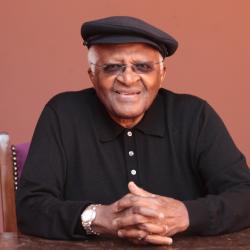
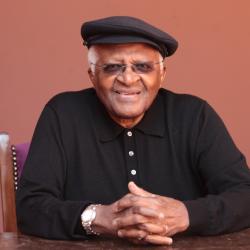
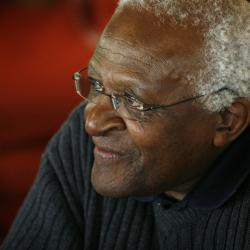

People like the Elders are not here to lead change, or end wars. They are here to remind you that wars can be ended.
Desmond Tutu
Anti-apartheid leader
“Perhaps oppression dehumanises the oppressor as much as, if not more than, the oppressed. They need each other to become truly free, to become human."
DESMOND TUTU
Nobel Peace Laureate
“To talk about ‘ethical leadership’ is to speak from experience, not because you were a perfect leader but because you were thrust into difficult situations – stirring hatred or calling for cool heads, igniting a war or enshrining peace, reaching out to the poor or assuming they will perish. And maybe you helped to see humanity prevail."
DESMOND TUTU
Healing South Africa’s wounds
“Forgiveness is not just an altruistic act, but one born of self-interest. Forgiveness helps give people the resilience to survive and remain human in the face of all efforts to dehumanise them.”
DESMOND TUTU
The ‘world’s moral conscience’
“If you are neutral in situations of injustice, you have chosen the side of the oppressor.”
DESMOND TUTU
Anti-apartheid leader
“Perhaps oppression dehumanises the oppressor as much as, if not more than, the oppressed. They need each other to become truly free, to become human."
DESMOND TUTU
Nobel Peace Laureate
“To talk about ‘ethical leadership’ is to speak from experience, not because you were a perfect leader but because you were thrust into difficult situations – stirring hatred or calling for cool heads, igniting a war or enshrining peace, reaching out to the poor or assuming they will perish. And maybe you helped to see humanity prevail."
DESMOND TUTU
Healing South Africa’s wounds
“Forgiveness is not just an altruistic act, but one born of self-interest. Forgiveness helps give people the resilience to survive and remain human in the face of all efforts to dehumanise them.”
DESMOND TUTU
The ‘world’s moral conscience’
“If you are neutral in situations of injustice, you have chosen the side of the oppressor.”
DESMOND TUTU
Desmond Tutu
1984
1986
1994
2007-2013
Despite all of the ghastliness in the world, human beings are made for goodness. The ones that are held in high regard are not militarily powerful, nor even economically prosperous. They have a commitment to try and make the world a better place.
Desmond Tutu
Work with The Elders
Known affectionately as ‘Arch’ by his fellow Elders, Desmond Tutu helped bring the group together in 2007 and served as its much-loved Chair until he stepped down in May 2013. He continued to support the group as an “Elder Emeritus” until his death in 2021.
One of the world’s best known advocates for peace and reconciliation, Archbishop Tutu travelled to Cyprus with the Elders several times to encourage reconciliation between Greek Cypriot and Turkish Cypriot communities; to Israel and the occupied Palestinian territories to promote a just and secure Middle East peace; to Côte d'Ivoire, where the Elders encouraged national reconciliation following the post-election violence of early 2011; to Sudan and South Sudan to highlight humanitarian needs and the importance of dialogue between political leaders; In 2014, he joined an Elders delegation to Iran, meeting President Rouhani and key Iranian figures to promote peaceful solutions to conflict and sectarian divisions in the region.
A vigorous champion of youth empowerment, Archbishop Tutu took part in several intergenerational initiatives, including Elders+Youngers and The Elders’ intergenerational climate blog series. He also travelled to Ethiopia with The Elders in June 2011, and to India in February 2012, to support communities tackling the harmful traditional practice of child marriage.
Anti-apartheid archbishop
Desmond Tutu began his career as a high school teacher but turned to theology after the 1953 Bantu Education Act enforced racial segregation in all educational institutions in South Africa. He was ordained as an Anglican priest in 1960, becoming the first black Anglican Dean of Johannesburg in 1975 and the first black General Secretary of the South African Council of Churches four years later. An outspoken critic of the apartheid government, he insisted that racial segregation was against God’s will. He soon became well-known internationally for his commitment to non-violence and support for economic sanctions against apartheid South Africa.
Desmond Tutu was awarded the Nobel Peace Prize in 1984 "for his role as a unifying leader figure in the non-violent campaign to resolve the problem of apartheid in South Africa." In 1986 he was elected Archbishop of Cape Town, the highest position in the Anglican Church in South Africa. Widely regarded as 'South Africa's moral conscience', he continued to speak out against the apartheid regime and organised many peaceful demonstrations with thousands marching beside him.
Truth and reconciliation
In 1994, after the end of apartheid and the election of Nelson Mandela as President of South Africa, Desmond Tutu was appointed Chair of South Africa's Truth and Reconciliation Commission to investigate apartheid-era crimes. The model he established was based on truth as a foundation for forgiveness and reconciliation and became central in healing South Africa's divided society. Archbishop Tutu believed that: “without forgiveness there can be no future for a relationship between individuals or within and between nations.”
Tutu retired as Chair of the Commission in 1998 and shared his experience and advice with those undertaking their own truth and reconciliation processes in post-conflict societies, from Northern Ireland to the Solomon Islands.
Advocate for peace and justice
Despite announcing his retirement from public life in 2010, Desmond Tutu continued to stand up for those who are poor and oppressed, to raise awareness of global crises such as the AIDS pandemic and climate change, and to advance peace and reconciliation worldwide. Alongside his wife, Leah, Archbishop Tutu continued to work through the Desmond & Leah Tutu Legacy Foundation with the objective of promoting peace-building through conflict resolution, fostering reconciliation and cultivating accountable servant leadership until his death in 2021.
Archbishop Tutu's ability to convey difficult messages with clarity, compassion and conviviality made him one of the most loved and respected activists of our time. As his great friend Nelson Mandela said of Tutu, he was “sometimes strident, often tender, never afraid and seldom without humour.”